




13 April-May 2008 (Wednesday through Saturday from 12-4pm)

The Hammond Museum

28 Deveau Rd, North Salem, NY 10560

 "See how water strikes the mountain and pierces the rocks; nothing is stronger."

--Mustard Seed Garden Manual of Painting

The power of water, with its penetrating as well as its yielding aspects, is central to the vision of riverrun. We walk into the river, water parts before us; yet the rivers are formed by the water's gouging and reshaping of the landscape. This vision is the genesis of Susan Haire's and Stephen Dydo's collaboration. Through the pairing of the sonic and the visual, they tell us of their awe of the many-faceted power of the river.
riverrun: Detail, 2008, acrylic on paper on board


The Installation

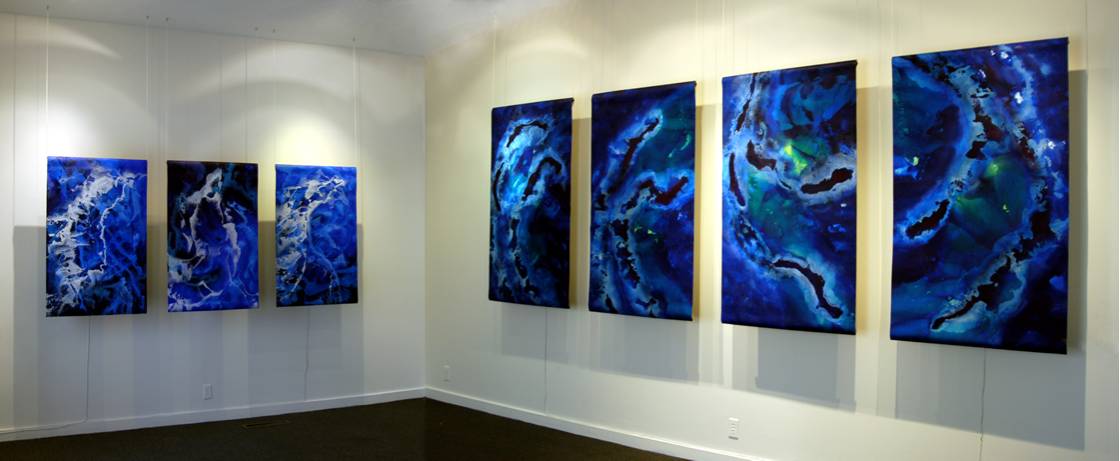
A single room creates the environment. When the visitor walks in, a complex but unified sound will meet her, and an equally complex but unified palette of colors will cover the walls. As she walks from one painting to the next, the discrete shapes of the paintings will emerge, as will new sounds, new music.

The Paintings

Water itself is an important tool in the making of Haire’s work. The paint is put down wet on wet and the paintings are put under running water before the paint is dry. Haire fully exploits the fluid qualities of paint, mirroring the characteristics of water in nature. The work, focusing on the power of water, will contribute to the creation of a distinct atmosphere within the gallery space. The paintings will be hung in front of the walls, in the manner of Chinese scrolls; however, they will be suspended somewhat away from the walls, both leaving space for loudspeakers behind them and also giving them a disembodied, ethereal character. Some paintings will be hung in groups, while others will stand solitary.

The Music

The visual experience will have its counterpart in the central musical theme, a melody played on a Chinese classical instrument, the qin, as well as a restored harp from the Tang dynasty (618-907), the konghou. The music is based on two melodies from that time, Qin River Birds and River Waters. The arrangement of this ancient music will be completely new. As the visitor walks around the installation, separate loudspeakers will project separate aspects of the music at the locations of individual paintings and groups of paintings. Some of it will be recorded music, including qin and konghou music, some will be electronically manipulated instrumental and natural sounds, and some will be purely electronic. Sometimes a musical idea will travel around the room, bouncing from one painting to another. All will be facets of a single musical work.